Insights
A board asks what a launch returns
Is the gap in physician demand, or in sites still getting ready?
October 25, 2026
· Life sciences
· 9 min read
A board asks what a launch returns before it approves the plan, and again at every review after. The answer shapes what the board funds, when the next financing comes and where the field team spends its time. A launch ahead of plan draws few questions. When it falls behind, the board needs to see which part of the return fell short before it funds a fix. In the illustrative launch below, physicians order a little above plan, and most of the first-year shortfall sits with 16 sites still getting ready.
A hypothetical new PET agent, one year after launch. Every launch number below comes from a model you can download at the end.
The first-year review opens with revenue at $3.8 million against a plan of $4.7 million. Payback has slipped from Year 2 into Year 3, and one board member already has a fix, another $1 million of promotion. It sounds right, because fewer orders than planned look like a demand problem, and promotion is how a launch builds demand.
Before the money moves, the board needs one answer. Are physicians ordering less, or are fewer sites ready to perform the scan? The answer decides where the next dollar goes. A launch like this one is often a bet on sites before it is a bet on physicians.
Why does a readiness gap look like weak demand?
Every dose of a new PET agent needs a site ready to perform the scan and a physician or other practitioner who orders it. Revenue counts doses, so it shows only whether the dose happened. On the revenue line, a site still in setup looks just like a site whose physicians stick with today’s scan.
Count the sites in this launch, and the picture changes. Of the 80 sites the plan counted on by year end, 64 are ready, and their physicians order a little more than planned. The shortfall sits with the other 16, still waiting on internal approval, a contract, training or billing.
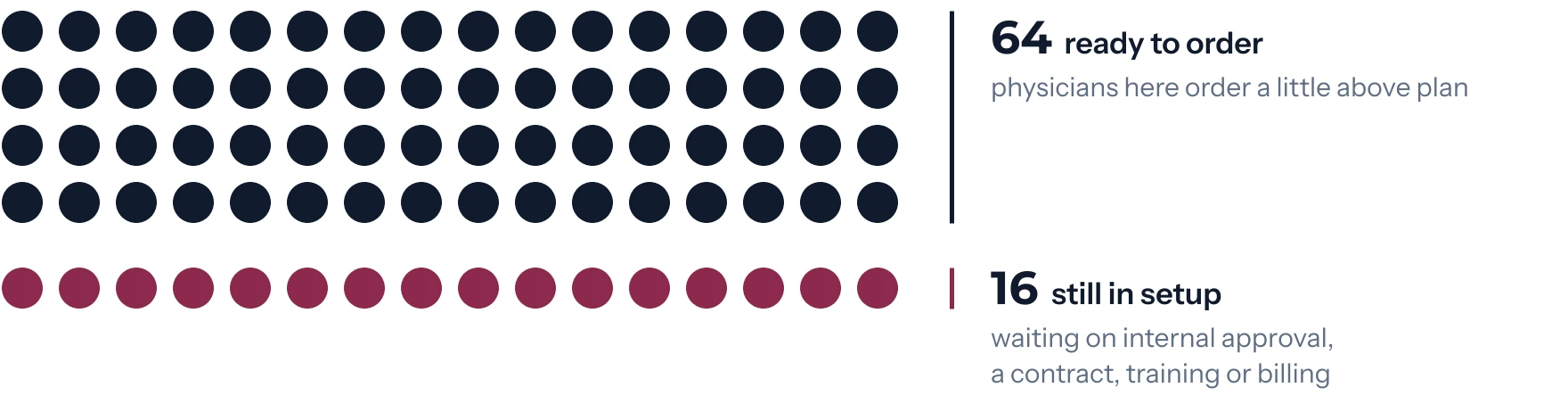
Demand is doing its part, and readiness is the larger gap. Readiness can also move slowly. At a hospital, adding a new agent waits on internal approval processes, while at an imaging center the decision often rests with fewer people. Where the label calls for an education program, reading physicians complete it before they read the first scan.
What does slow readiness do to the return?
In this launch, a ready site returns about $13,000 a quarter after dose costs. That puts the price of waiting at about $210,000 a quarter for the 16 sites in setup. Yet the pace costs more than the wait. This launch gets four sites ready for every five the plan expects, so the shortfall widens every quarter.
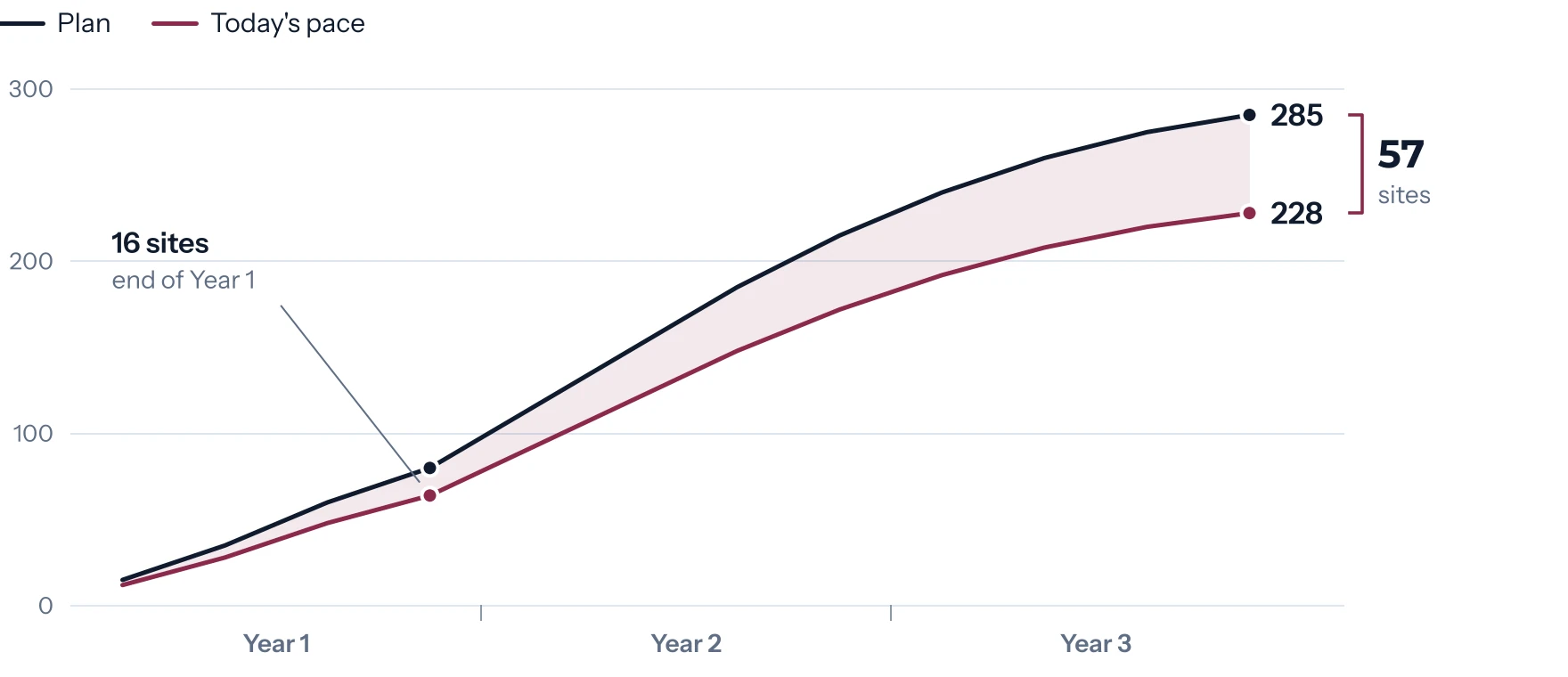
At this pace, the shortfall reaches 57 sites by the end of Year 3, and the price of waiting more than triples. If the first-year pattern holds, net return reaches $7.8 million by then, against the plan’s $13.8 million. Slow readiness accounts for about $5 million of that gap.
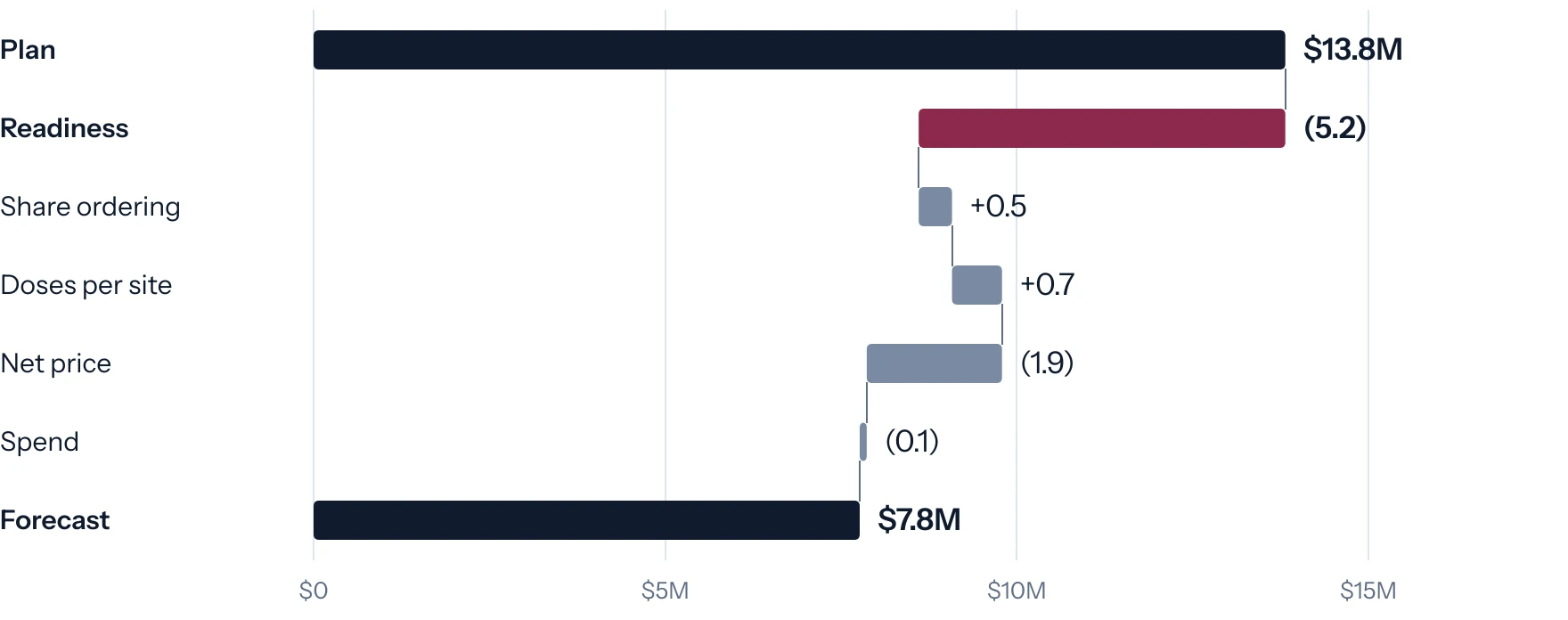
Two other forces pull in opposite directions. Extra orders at ready sites win some of the gap back, though the first sites to get ready may be the most eager. The launch also nets $120 a dose less than planned, a gap finance can trace to channel fees, access terms or payment status.
Price carries an assumption of its own. Both the plan and the forecast hold net price flat through Year 3. That assumes Medicare’s hospital outpatient pass-through payment runs the full three years the law allows, from the first dose. After it, CMS pays a diagnostic radiopharmaceutical separately above a per-day cost threshold, $655 in 2026. A shorter term, or a lower rate after it, can change Year 3 price. Your market access and legal teams decide how these rules apply.
Where should the next $1 million go?
In this launch, the next dollar has better odds where it moves slowest, so we would put the $1 million into readiness first. It pays field and market access teams to support each site’s internal approval, contract, training and billing through Year 2, as compliance allows.
Suppose that spending restores the plan’s pace and clears the 16 during Year 2. By the end of Year 3, it can then add $3.2 million of net return, after paying for itself. Most of that gain arrives in Year 3, after the money stops. Payback can come back to the last quarter of Year 2, one quarter behind plan, though only by about $60,000. Two fewer new ready sites in Year 2 would leave it in Year 3.
With the same money, clearing the 16 sites in setup alone adds only about $0.4 million, also after its cost. The backlog is the visible problem; the pace is the expensive one.
The money could also go to promotion, and the board can hold either use to a test.
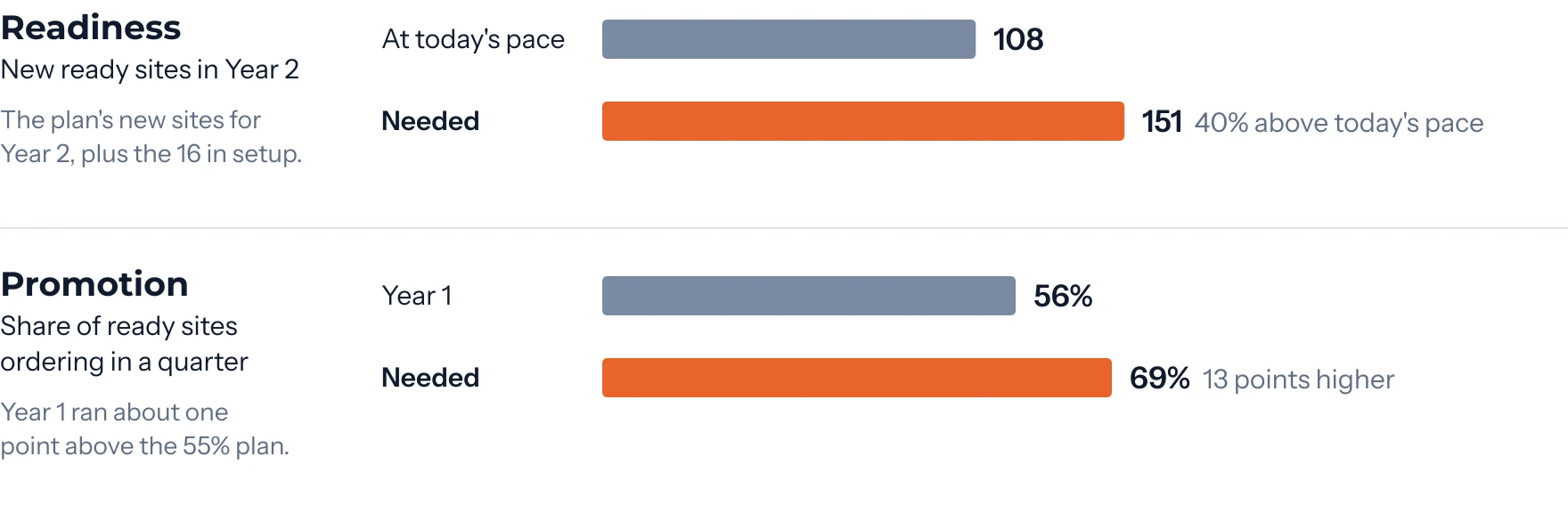
The readiness test asks for the pace the board already approved, plus the 16 in setup. In Year 2, that means 151 new ready sites, about 40 percent more than today’s pace would deliver.
The promotion test asks more of physicians. To match readiness, the share of ready sites ordering would have to jump 13 points and hold there. In the first year, that share beat plan by about one point. A jump that size runs into how the scan gets ordered.
A referring physician tends to order the scan when it answers a clinical question better than today’s option, with guidelines and coverage behind it. The reading physician has to trust the image. Where agents compete, the imaging department’s protocol and supply contract can decide which one fills the order.
Marketing works on both sides. It finds the physicians whose patients fit, speaks to each one’s clinical question within the label and builds the reading physician’s confidence. With market access, it also equips readiness, with the evidence a site’s internal approval process reviews and the billing guide a site needs. Promotion still earns its place when aimed at physicians who refer to ready sites, because that can turn readiness into orders.
What can the board see before revenue arrives?
Readiness and demand both show up before revenue does. The field lead can count ready sites every week. To see demand site by site, add dose data rights to any manufacturing or distribution agreement that lacks them, now or at renewal. Your legal team decides the terms.
Two signals then sort the sites. A site waiting on approval or billing has a readiness gap. A ready site that keeps moving its first scan date may have a demand gap.
Last, set one alarm. Any drift in readiness, demand or price that costs a tenth of the planned return goes to the board.
What should the team decide this quarter?
Three decisions, in order.
- Split the Year 1 gap into readiness, demand and price before approving new promotion.
- Where readiness drives the gap, fix the readiness process and clear the backlog together. Sort the sites in setup by blocker, each with an owner and a date.
- Aim new promotion at physicians who refer to ready sites, once readiness is back on pace.
On Monday, ask the team three questions. How many target sites are ready to order today, against plan? What is holding up the rest, site by site? Which ready sites have yet to place a first order, and why?
If the answers come slowly, the board is funding an estimate.
The first step is a conversation about your launch. Bring the question your board is asking. We read your numbers the way this piece reads its illustrative launch, through readiness, demand and price, site by site.
At jscTEK, we understand product launches, and our work includes these three.
- An FDA launch, from pre-launch positioning and build through two years of operation.
- A physician targeting analysis built from federal claims data, then a market entry model for the United States and Europe.
- A commercial plan for the United States market, then the brand system and platform built to carry it. The plan set the segments, the targets and the forecast the launch was measured against. The numbers stay with the client.
Run your own first year. Download the illustrative model and type in your Year 1 actuals for a first look at your own gap.
Sources
- CMS instituted pass-through payments for new diagnostic radiopharmaceuticals. Marwood Group, “Diagnostic Radiopharmacy: Overview And Market Access Considerations,” Mark Slomiany, April 4, 2023. Accessed October 11, 2026.
- Transitional pass-through payments for a drug or biological last at least two and at most three years. CMS, “Hospital Outpatient Prospective Payment System (OPPS),” page modified March 10, 2026. Accessed October 11, 2026.
- Separate payment above a per-day cost threshold once pass-through ends; at or below it, the cost is packaged. Sidley Austin LLP, “Medicare Payment Policy Final Rule for Outpatient Setting Addresses Radiopharmaceuticals, Skin Substitutes, and 340B Program Key Topics,” December 2, 2025. Accessed October 25, 2026.
- The 2026 threshold, $655 a day, up from $630. Society of Nuclear Medicine and Molecular Imaging, “CMS Releases Final CY 2026 Hospital Outpatient Prospective Payment System (OPPS): Implications for Nuclear Medicine,” November 24, 2025. Accessed October 25, 2026.