
Insights
What an FDA-regulated product asks of a website
What changes for your website the day your product is approved?
October 25, 2026
· Life sciences
· 8 min read
On the design side, we see four things an FDA-regulated product, such as a prescription drug, often asks of its website. They are one argument for every reader, safety information beside every claim, a gate matched to each path and a record of every version. Each can be built into the templates and approved by your review committee before the first page.
Picture the review meeting three weeks before launch. The brand team has the product site on the big screen, and the medical, legal and regulatory reviewers each bring a marked-up copy. The medical reviewer opens the home page on a phone, scrolls past the efficacy headline and finds the safety information four screens down. The legal reviewer asks who can reach the dosing page. The regulatory reviewer asks how anyone will match the live page to its approved version.
Each question is about how the site is built, and each one sends a page back. The answers belong in the templates, the layouts every page is built on. From approval on, the product website speaks for an approved drug. FDA’s nonbinding draft guidance says a company is responsible for promotion on sites it owns, controls, creates, influences or operates, directly or through others.
The FDA documents cited here cover prescription drugs, and your regulatory and legal teams decide how they apply to your site. This piece looks at the design side, through websites jscTEK launched for FDA-approved products.
Who does the site have to persuade?
Often more than one room. On a website jscTEK launched for an FDA-approved product, two rooms had to hear the same thing. Nuclear medicine acquires and interprets the scan, while neurology decides a patient needs one. Those audiences read different journals, attend different meetings and search different terms, so a message pitched at the midpoint arrives diluted in both.
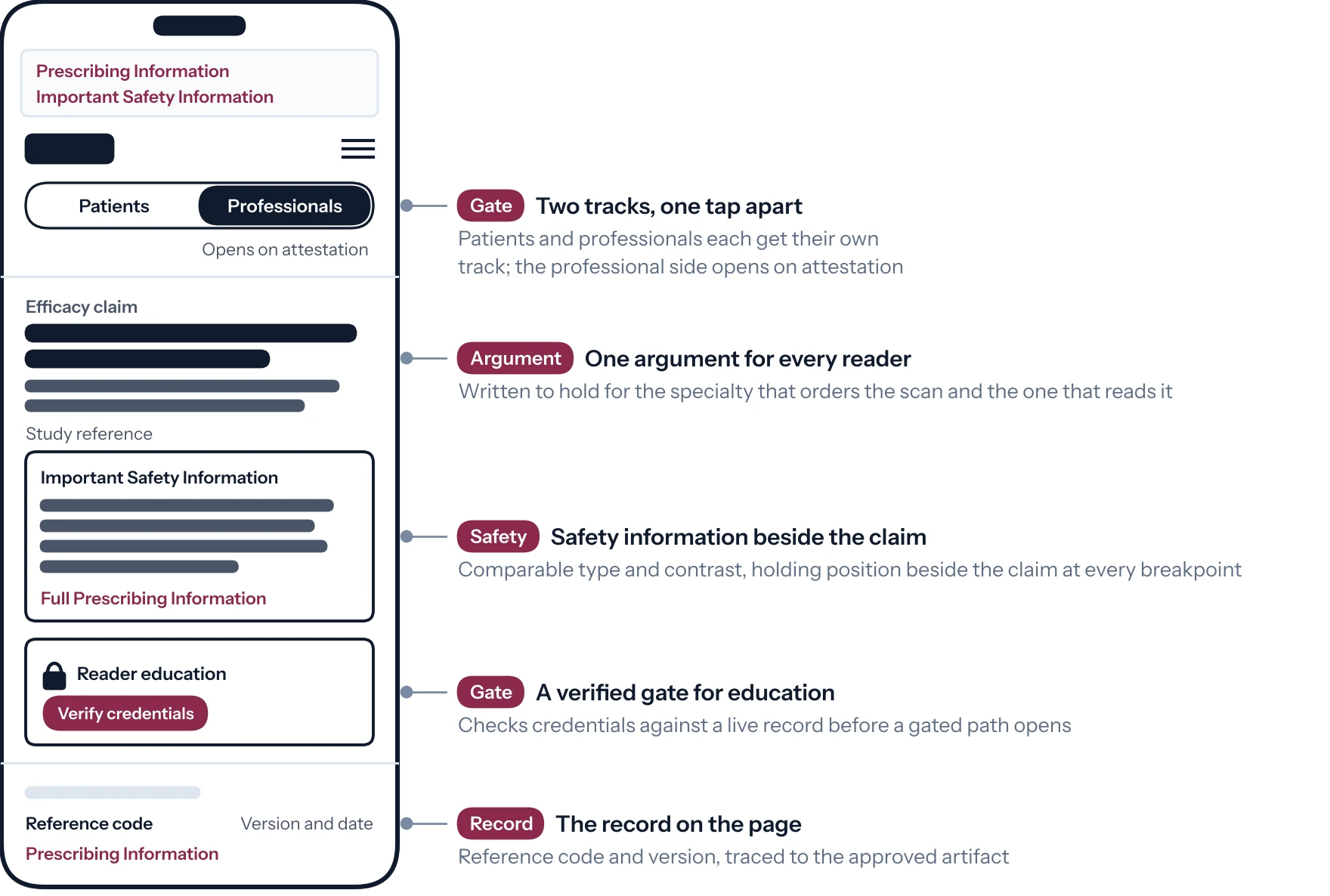
jscTEK’s answer was one claims architecture, a term for the ranked claims a brand makes and the evidence behind each. Unlike a midpoint message, it held for the reader of the scan and the neurologist who orders it. The argument at the booth was the argument on the product page. The site had a consumer side too. The consumer and professional sides each had their own track within one click.
Another launch jscTEK worked on faced the same split. Its positioning was aimed at the physicians who order the agent and the physicians who read it, rarely the same people. The campaign carried that argument across the site, the field and the meeting, holding its shape in each.
For an approved product, one argument also matters to review. Every claim on the site usually goes through the committee, and each new argument adds claims to clear and keep in step.
Where does the safety information belong on every page?
Beside every claim, at every screen size. A physician may read one page between patients, so we design each page with a claim to carry its own safety information.
The FDA’s binding rule for prescription drug ads calls for balance, a test your regulatory team may apply to the site. Under it, an ad may lack fair balance if side effect and contraindication information lacks “a prominence and readability reasonably comparable” with effectiveness information. In judging that, the rule takes into account factors such as typography, layout, contrast, headlines, paragraphing and white space. Most of those are set in the template.
We see balance as part of the persuasion. A physician often reads promotion for what it leaves out. A page with its risks beside its claims can give that reader less to doubt. The danger is a layout that buries risk by accident. On a laptop, the Important Safety Information, the summary of risks, sits beside the claim. On a phone, the same layout can push it four screens down.
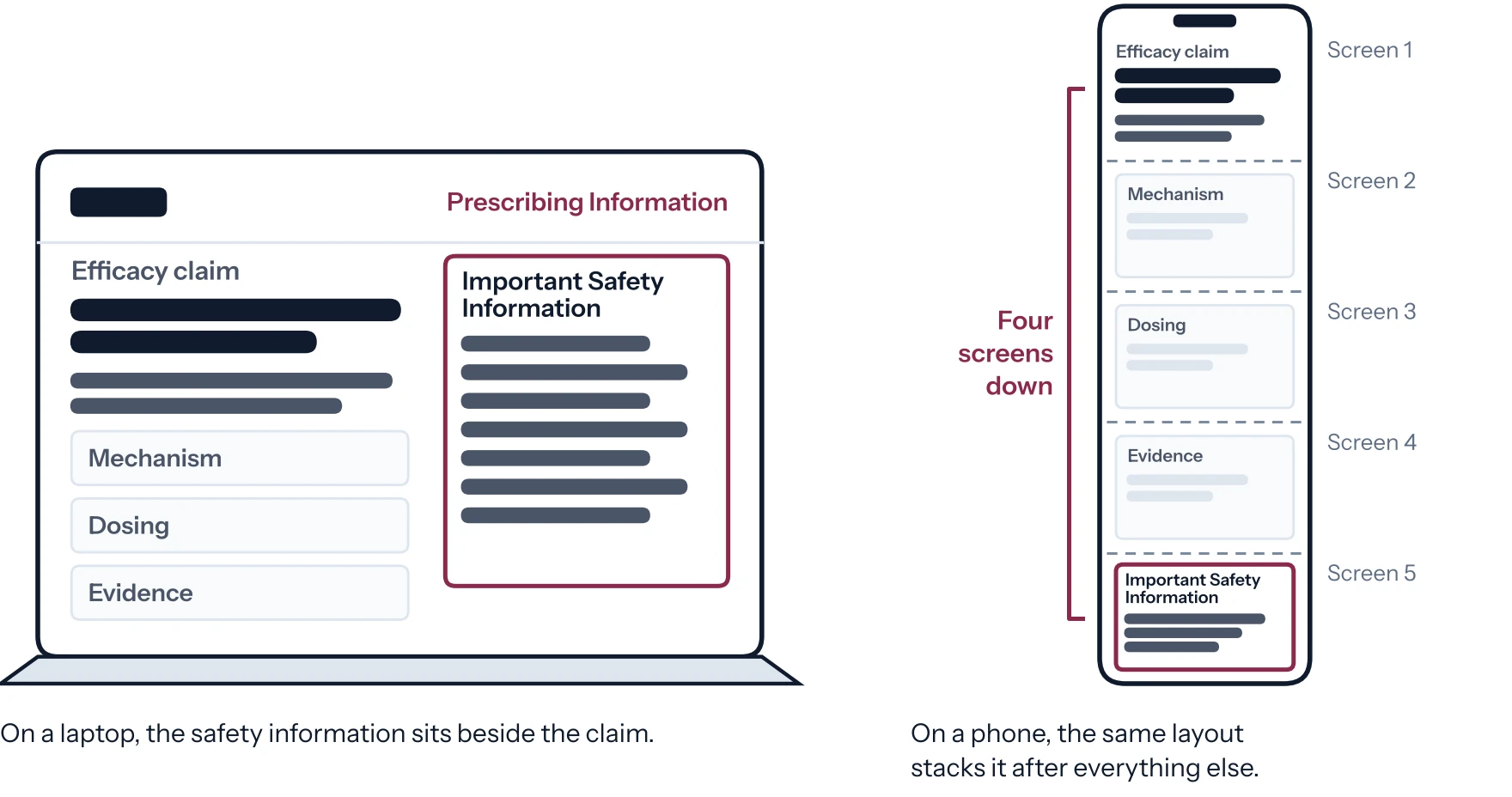
Phones and laptops part ways at breakpoints, the screen widths where a layout rearranges. On the site built for the two specialties, Important Safety Information was designed to hold position alongside promotional content at every breakpoint. Full Prescribing Information was designed to stay within reach from every page. The site’s templates, components and copy decks were structured for medical, legal and regulatory review.
On the other launch, the build made room for safety information, Prescribing Information routing and promotional review from the first template. In practice, the template carries the safety information, the Prescribing Information link and the claim layout, so every page inherits them.
Who should get through each gate?
An approved product’s site often carries content meant for some readers and closed to others, and gates decide who can open each path. A checkbox, called attestation, asks readers to confirm that they are healthcare professionals and takes them at their word. On the site built for the two specialties, the professional side opened on attestation.
A verified gate checks each physician’s credentials first, and the other launch needed one. Its reading physicians needed on-demand education on the agent’s scans, and that education had to reach licensed physicians only. So the education program, built into the product site, opened only to physicians whose credentials verified against a live third-party record. One property carried the brand, the clinical case and the education program, and a physician verified once to reach the material they needed.
The gates differed as the content behind them did, with attestation for a professional track and verified credentials for education. Your regulatory and legal teams decide which gate each path needs.
What does the site need after launch day?
A record. After launch come new data, label updates and questions from the field team, and each change usually goes back through review. The same draft guidance says a company should submit its entire static product website at first use. After a substantial revision, it should submit the whole site again. The guidance adds that a company updating one page or section can submit only the update, with a cross-reference to the original filing.
On the design side, we build version control into the template. On the site built for the two specialties, every asset carried its number, its reference code. Reference codes rendered on the page, and versions tracked back to the approved artifact.
What should the team decide this quarter?
Picture the review meeting again, this time with the templates approved first. The medical reviewer scrolls the phone view and finds the safety information under the headline. The legal reviewer sees the gate, and the regulatory reviewer reads the reference code off the page. Each new page is still reviewed, starting from parts already approved. A label change can reopen them.
Four decisions, in order.
- Settle one argument before the pages. Agree on the claims that hold for every reader, then give each audience its own track.
- Bring the review committee in at the templates. Ask it to approve the safety information block, the Prescribing Information link and the claim layout at every screen size, before the first page.
- Match each gate to what sits behind it. With your regulatory and legal teams, decide which paths open on attestation and which call for verified credentials.
- Put the reference code on every page. Trace each version to its approved original, and name one owner for the list of live pages.
On Monday, ask the team three questions. On a phone, how far does a reader scroll from the efficacy headline to its safety information? Which pages verify credentials, and which take the reader’s word? If the dosing page changed today, who would send the new version to the FDA?
If it takes a meeting to answer them, your templates could be doing more of the work.
The first step is a conversation about your site. Bring a page from your last review, and we look at where its template places the safety information, the gate and the reference code. Safety information set as an image of text can fail a criterion of WCAG 2.1 AA, a web accessibility standard. We look for that too. What we see is design input, and your own teams make the conformance calls.
At jscTEK, we understand product launches. More of what we build is on our Work page.
Sources
- The sites a company answers for, and what it submits. U.S. Food and Drug Administration, “Fulfilling Regulatory Requirements for Postmarketing Submissions of Interactive Promotional Media for Prescription Human and Animal Drugs and Biologics,” draft guidance for industry, January 2014, docket FDA-2013-N-1430, marked “Contains Nonbinding Recommendations.” Footnote 6 covers static materials such as a static product website. Still listed as a draft on FDA’s guidance page, content current as of January 3, 2019. Accessed October 18, 2026.
- The design factors in the rule. 21 CFR 202.1(e)(7)(viii), “Prescription-drug advertisements,” Electronic Code of Federal Regulations, up to date as of October 15, 2026. Accessed October 18, 2026.
- The web accessibility standard. W3C, “Web Content Accessibility Guidelines (WCAG) 2.1,” W3C Recommendation, this version dated May 6, 2025, including Success Criterion 1.1.1 Non-text Content (Level A) and Success Criterion 1.4.5 Images of Text (Level AA). Accessed October 18, 2026.