
Insights
What referral sources need from a provider’s website
What do the people who send you patients look for when they open your site?
October 25, 2026
· Healthcare
· 11 min read
Referral sources, the physicians, discharge planners and office staff who send you patients, often read your website with a patient waiting. They tend to ask whether you can take the patient, how the referral reaches you and whether to trust you. Your intake team likely knows most of the answers, so the page that publishes them needs an owner in operations.
Picture a discharge planner late on a Thursday. A patient goes home tomorrow, the family wants home health, and the planner has a list of agencies to work through. The patient chooses an agency, often from that list, and the planner checks who can take the case. For every name on the list, one answer comes first. Can you take this patient?
Across town, a cardiology office is sending a scan order and wants to know how. Elsewhere, a physician who just met your liaison is still deciding whether to trust you with a patient at all. Three people bring three questions to one website, and each can end in a referral that fills your schedule and census.
Intake usually holds those answers, from the plans you accept and where you serve to who confirms a referral. The website’s job is to put those answers one click from any page. Since intake holds the facts, we would treat the referral page as an operations asset that happens to live on the marketing site. It tends to stay accurate while someone in operations owns it.
- What you treat
- Payers, by plan name
- Where you serve
- How soon care can start
- Ages and levels of care
- Refer a patient, on every page
- Secure online form
- Fax and printable form
- Intake line and hours
- What to send
- What happens next
- Who provides care
- Credentials and quality data
- How updates come back
- A named contact
Can you take this patient?
The first question is fit, and fit is specific. It means this patient, this coverage, this address and this week. So the page names what you treat and the plans you accept, shows where you serve and states how soon care can start. Place and timing weigh on referral choices. A 2022 review of seven US studies found location, scheduling and patient preference among the factors referring providers cite most when choosing specialists.
Each line of care adds its own facts. A behavioral health program adds the ages and levels of care it serves. A hospice adds how soon it can admit, weekends included. Publish those times in wording compliance has approved.
Home health shows how much rides on the map. Medicare’s discharge planning rule binds hospitals. For a patient referred to home health, the hospital must list available Medicare-participating agencies that serve the patient’s area, as each agency defines it. The rule adds that home health agencies “must request to be listed by the hospital as available.” If your website draws a different map from the one the hospital holds, the planner can face two answers and a phone call. Each rule cited here names who it binds, and your regulatory and legal teams decide how it applies to you. This piece looks at the website.
Fit facts go stale quietly. A dropped plan can sit on the payer page all summer, until an office sends a patient on the strength of it. Growth tests the page’s owner hardest, since a new location or an add-on brand can launch with last year’s payer list.
How do I send this patient?
The second question is the route. An office ready to refer should reach it in one click from any page, ideally through a “Refer a patient” link in the header. From there, the best referral page behaves like your best intake coordinator and takes the referral however the office sends it.
That still includes paper. In 2025, nearly three in four general acute care hospitals mailed or faxed care summaries, at least sometimes, for patients leaving their system. So the page offers a secure online form, a fax number with a printable form and the intake line with its hours. Offices that refer from their EHR find your Direct address, a secure messaging address many EHRs support, and the referral platforms you accept. The form sends patient details straight to intake, and your privacy officer decides which tags and tools run on the referral path.
Like a good coordinator, the page also tells the office what to send and what happens next. Who confirms the referral, how soon, and who handles prior authorization? We build intake on one rule, as few steps as the questions allow. A form that asks for the same details twice can spend goodwill your liaison worked hard to earn.
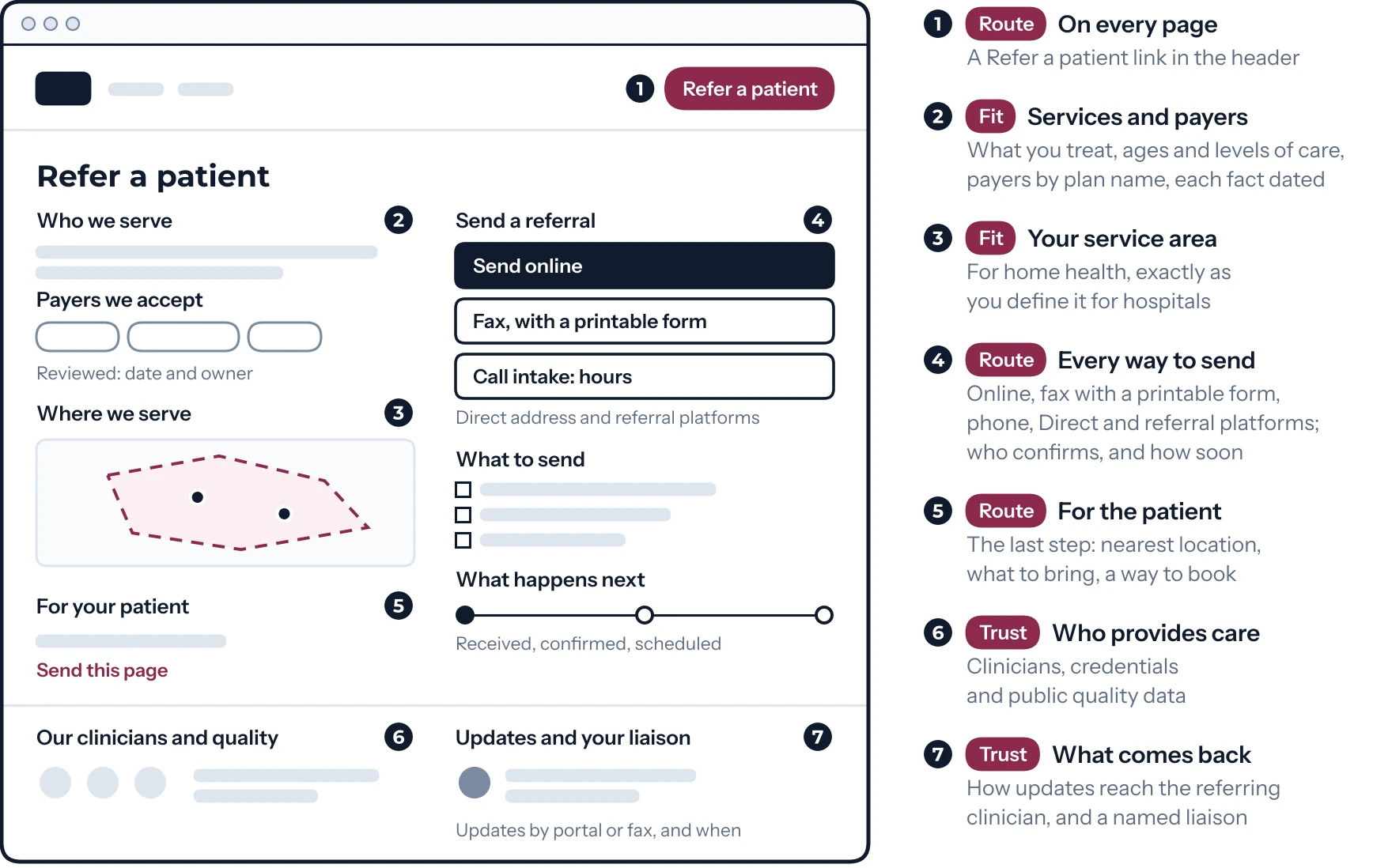
The last reader is the patient, and referrals can stall there. In an academic primary care network, from mid-2015 to mid-2016, nearly one in five patients referred to specialists declined to schedule or were unreachable. The records left the declines unexplained. We read that as a gap a good page can help close. Where it fits, the office sends the patient one link, with the nearest location, what to bring and a way to book.
Every route on the page has to open for every reader. The page, the form and the patient’s link all have to work on a phone and with a keyboard or screen reader. That is good service, and for some providers a federal rule also sets a standard. HHS’s Section 504 rule will require recipients of HHS financial assistance to meet WCAG 2.1 AA, a web accessibility standard, with some exceptions. That includes content provided “through contractual, licensing, or other arrangements.”
For recipients with 15 or more employees, compliance begins May 11, 2027, after an interim final rule extended the date by one year. For smaller recipients, it begins May 10, 2028, and HHS plans further rulemaking on the rule’s requirements.
Can I trust you with this patient?
The third question is trust, and a provider earns it twice, before the first referral and after every one.
Before the first referral, a physician often wants to know who will care for the patient. So show the clinicians, their credentials, your accreditations and any public quality data. That data has other readers too. Medicare’s discharge planning rule requires hospitals to share quality and resource use data as patients choose where to go after the hospital. Any quality data on your site should match its public source, named and dated.
After the referral, trust often rests on what comes back, and the two sides see it differently. In a 2008 national survey, four in five specialists said they usually sent their results back. Only three in five primary care physicians said they usually received them.
Medicare’s quality program for clinicians includes a measure for that loop, for those who choose to report it. Its 2026 version tracks how often the referring clinician receives a report from the clinician the patient was referred to. The measure’s guidance says the referring clinician “should be held accountable for the performance of this measure.” In our view, that is one more reason to say how results come back. Where privacy rules allow, say on the site how updates reach the referring clinician, by portal, fax or a named contact, and how fast.
Trust can also depend on the site and your liaisons saying the same thing. For a client working with imaging centers and physicians, we rebuilt the website as the surface every other channel points back to. A brochure, a booth conversation and a social profile all end in the same place. A practice manager who meets that client at a conference, on a leave-behind and on the site meets one description, three times. Repetition is what turns a description into a position.
What should the team change this quarter?
Three decisions, in order.
- Walk the referral path the way your referral sources do. Start from a search, a leave-behind and, for home health, a hospital’s agency list, and count the clicks to each answer. Then track referrals by route in your intake system, and how long each waits.
- Give the referral page an owner in operations. Intake holds the facts, so intake reviews them on a set date, and every new location launches with its page complete.
- Make the site and your liaisons say the same thing, in approved words. Add how updates come back and a named contact for each territory.
On Monday, ask the team three questions. If a discharge planner opened our site right now, how many clicks would it take to find our service area and payers? Where does an online referral go, and who answers it? When did someone last check the fax number, payers and hours on every location page?
Whoever can answer that last question is the page’s real owner today, whatever the org chart says.
The first step is a conversation about your referral path. Tell us how referrals reach you today, and we walk your site with you, asking this piece’s three questions of fit, route and trust. The walk includes the page, the form and the patient link, on a phone and with a screen reader. What we see is design input, and your compliance team makes the conformance calls.
At jscTEK, we understand how healthcare buyers decide. Our clients include a company that works with imaging centers and physicians to expand their molecular imaging programs.
Sources
- What referring providers weigh. Caitlin B. Finn and others, “How Referring Providers Choose Specialists for Their Patients: a Systematic Review,” Journal of General Internal Medicine, volume 37, issue 13, pages 3444 to 3452, April 19, 2022, a review of seven studies performed in the United States. Accessed October 17, 2026.
- The discharge planning rule. 42 CFR 482.43, a condition of participation for hospitals in Medicare, Electronic Code of Federal Regulations, up to date as of October 15, 2026. Accessed October 17, 2026.
- Hospitals sending care summaries by mail or fax. Assistant Secretary for Technology Policy (ONC), “Methods Used by Hospitals to Engage in Interoperable Exchange,” last updated February 2026, from the American Hospital Association IT Survey of non-federal general acute care hospitals, 2018-2025. In 2025, for mail or fax, 40 percent of hospitals answered often and 34 percent sometimes. Accessed October 17, 2026.
- Referred patients who declined to schedule or were unreachable. Malhar P. Patel and others, “Closing the Referral Loop: an Analysis of Primary Care Referrals to Specialists in a Large Health System,” Journal of General Internal Medicine, volume 33, issue 5, pages 715 to 721, 2018, covering referrals from July 1, 2015 to June 30, 2016. Six percent of all referred patients could not be contacted to schedule, and 12 percent declined scheduling for unclear reasons, together 18 percent, nearly one in five. Accessed October 17, 2026.
- What comes back to the referring physician. Ann S. O’Malley and James D. Reschovsky, “Referral and Consultation Communication Between Primary Care and Specialist Physicians: Finding Common Ground,” Archives of Internal Medicine 171(1), 2011, from the 2008 Center for Studying Health System Change Health Tracking Physician Survey. In it, 80.6 percent of specialists said they always or most of the time send consultation results to the referring physician, and 62.2 percent of primary care physicians said they always or most of the time received such information. Accessed October 17, 2026.
- Closing the referral loop as a quality measure. Centers for Medicare & Medicaid Services, eCQI Resource Center, “Closing the Referral Loop: Receipt of Specialist Report,” CMS50v14, 2026 performance period, reported in MIPS. Accessed October 17, 2026.
- The web accessibility standard, who it covers and the compliance dates. 45 CFR 84.84, Electronic Code of Federal Regulations, up to date as of October 15, 2026 (89 FR 40193, May 9, 2024, as amended at 91 FR 25507, May 11, 2026). Compliance begins May 11, 2027 for recipients with fifteen or more employees, and May 10, 2028 for fewer. Accessed October 17, 2026.
- Exceptions to the standard. 45 CFR 84.85, “Exceptions,” Legal Information Institute, Cornell Law School, covering archived web content, preexisting conventional electronic documents, content posted by a third party, individualized password-protected or otherwise secured documents, and preexisting social media posts. Accessed October 25, 2026.
- The 2026 extension and further rulemaking. HHS Office for Civil Rights, “Extension of Compliance Dates for Nondiscrimination on the Basis of Disability; Accessibility of Web Content and Mobile Applications of Recipients of Departmental Financial Assistance,” interim final rule, 91 FR 25496, May 11, 2026, the latest Federal Register action found on October 17, 2026. Accessed October 17, 2026.